Queering the Stories We Inherit: Narrative Therapy, Childhood, and the Gendered Self
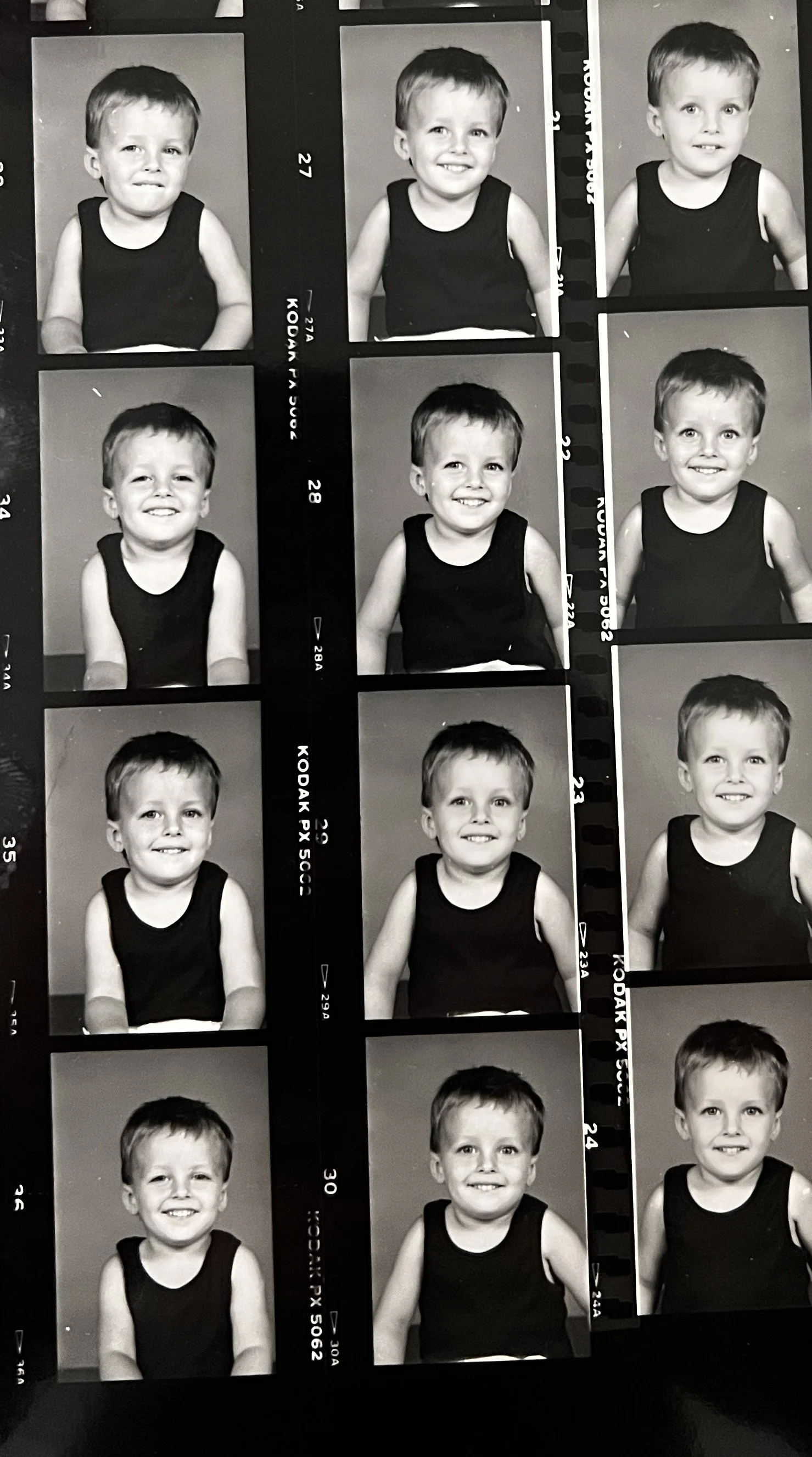
Images of me in childhood
It is within childhood that we first encounter stories about who we are. Gender reveal parties are proof that gender narratives are being crafted before children have a say in the matter. In the following critical reading analysis, I will hold in dialogue Kai Cheng Thom’s piece Children Deserve a New Paradigm with Julie Tilsen’s chapter Queer Theory and Narrative Therapy: Praxis Allies from their book Queering Your Therapy Practice. At the center of this comparative analysis stand trans, nonbinary, and gender-nonconforming children, alongside the inner children that continue to inhabit us all. All of these children, as they show up in therapeutic spaces, carry with them these gender saturated narratives. Queer theory and narrative therapy as therapeutic praxis partners offer opportunities to engage with these stories and to begin the work of subversion and new narrative creation, as Tilsen (2021) writes, “A queer theory-informed narrative therapy practice is about exposing and destabilizing normative ideas in order to create space to imagine new possibilities.”
Kai Cheng Thom shares the story of a six-year-old named Elie who, when posed with the question, “Do you feel like a boy or a girl?” answered with, “I feel 25 percent like a boy, and the rest is like a kid.” Elie is protecting three-quarters of their internal experience as a playground, a landscape open for exploration and discovery. Thom argues that children are often thrust into culturally dominant expectations of gender permanence, a belief that each person has one true gender identity. Thom frames this argument around concerns related to children and adolescents receiving gender-affirming care. What if children were offered a new “gender universe” as Thom describes it, a place where children and adults alike can be “letting go of the illusion that we can be completely sure of anything, releasing the idea of certainty in order to embrace the complex truth of being alive, messy, complicated.
Narrative therapy, as a therapeutic practice approach, is a process of inquiry with clients. In this approach, the therapist engages in earnest inquiry by asking questions that deconstruct discourses and generate meaning-making for clients. They bring forward people’s struggles and the responses to those struggles while simultaneously inviting their clients into an imaginary space about those struggles and responses (Tilsen, 2021). Tilsen describes queer theory as a sort of “always open app” listening to discourses of heteronormativity and cisnormativity. In this way, queer theory functions as a detection device for dominant narratives about our sexuality and gender. These dominant narratives function alongside oppressive structures that collude with the modernist notion of the "essential self,” which seeks to totalize and reduce individuals into a conception that sounds like, “this is who you are and forever will be.” Discomfort and public outrage about youth receiving gender-affirming care emanate from this dominant framework of the essential self, which rejects the notion that our identities are fluid and emergent along the entirety of life’s timeline.
Tilsen notes that narrative therapy practices attend to clients’ “problem-saturated stories,” often conveyed through “thin descriptions.” Such stories will impose absolute truths, resist multiple meanings, ignore power relations and context, and create little space for contradictions, all indicators of a thinly told story. Narrative therapy seeks out experience-near stories using broader or “thicker” descriptions.
Thom appears to be asking a question of caretakers and professionals working with trans, non-binary, and gender non-conforming children, which is, “How are we operating from a thin, problem-saturated narrative about this child’s life and their experiences of gender?” By suggesting we inhabit a more expansive “gender universe,” she essentially invites parents and professionals into an experience-near orientation with these children, eliciting broader and thicker narratives of their past and present experience and hopes for their future. By doing so, we find ourselves practicing queer theory in the here and now of gender experience with these children, and the inner children inhabiting our adult bodies. This is a “queer craft,” as Tilsen calls it, to “wonder outside the bounds of dominant discourses” and to engage in a sort of “double listening” to the dominant problem-saturated story and the unexpressed stories on the other side of the dominant ones.
As a future clinician, my practice will be narrative-relational oriented and consistently informed by queer theory and emergent strategy (brown, 2021). This critical reading analysis argues that where these practice modalities and critical theories meet, new possibilities emerge. Together, they create the conditions for Queer, Trans, and Non-Binary children and adults to reimagine the personal and sociocultural narratives through which they have come to know themselves.
What remains underemphasized in both Thom and Tilsen’s pieces are the responsibilities we have to past, present, and future children to completely dismantle the oppressive, modernist essentialized-self framework that undergirds the culturally dominant and oppressive systems creating the conditions of suffering for these children. A challenging question for me as a future clinician is, “How can I support people in navigating oppressive structures while simultaneously dismantling those structures at every level of their existence?” This is the practice of tending to the children across time: the wounded one we carry within us, the children living among us, and the children yet to inherit this world, so that new stories may take root and more liberated futures may flourish.
References
brown, a.m. (2021). Holding Change: The Way of Emergent Strategy Facilitation and Mediation. AK Press.
Tilsen, J. (2021). Chapter 3: Queer Theory and Narrative Therapy: Praxis Allies. Queering your therapy practice. In Routledge eBooks. p. 56-80. https://doi.org/10.4324/9781003011477
Thom, K. C (2023). Kids Deserve a New Gender Paradigm. The Walrus. (2023, March 20). https://thewalrus.ca/new-gender-paradigm/